
Poderá gostar
Detalhes do Produto
- Editora: Pearson
- Categorias:
- Ano: 2014
- ISBN: 9781292062358
- Número de páginas: 552
- Edição: 9.ª
- Capa: Brochado
Sinopse
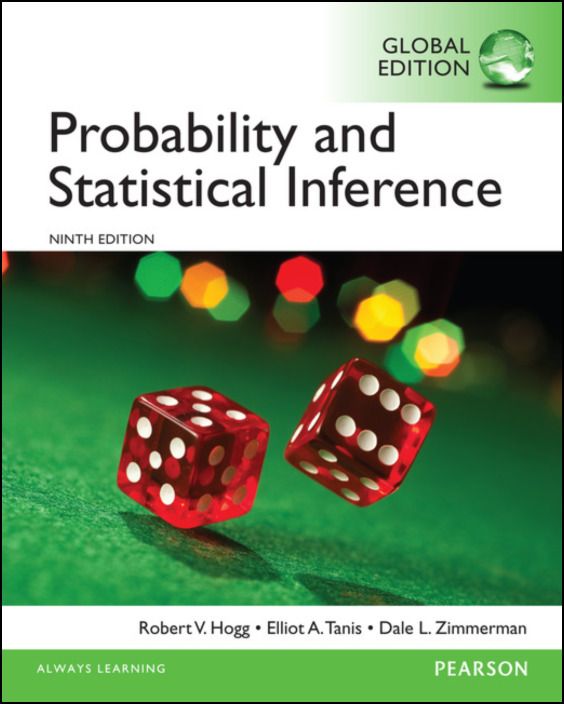
For a one- or two-semester course; calculus background presumed, no previous study of probability or statistics is required.
Written by three veteran statisticians, this applied introduction to probability and statistics emphasizes the existence of variation in almost every process, and how the study of probability and statistics helps us understand this variation. Designed for students with a background in calculus, this book continues to reinforce basic mathematical concepts with numerous real-world examples and applications to illustrate the relevance of key concepts.
Features
- The new organization presents information in a logical, easy-to-grasp sequence, incorporating the latest trends and scholarship in the field of probability and statistical inference. Balanced coverage of probability and statistics includes:
- Five chapters that focus on probability and probability distributions, including discrete data, order statistics, multivariate distributions, and normal distribution.
- The text’s second half emphasizes statistics and statistical inference, including estimation, Bayesian estimation, tests of statistical hypotheses, and methods for quality improvement.
- The student-friendly approach reinforces basic mathematical concepts, requiring just a calculus background.
- Application-oriented content features real-world scenarios in the exercises and examples, with applications in the areas of biology, economics, health, sociology, and sports.
- Integration of computer-based data and applications showcases the increased use of data and computers for calculating probabilities, analyzing data, solving problems, and conducting simulations.
- Historical vignettes at the end of each chapter outline the origin of the greatest accomplishments in the field of statistics, adding enrichment to the course.
- All of the data sets are available online at the Pearson Math & Stats Resources website in formats for use with most statistical software packages; enhanced figures from the text and Maple examples are also available.
New to this Edition
Dale Zimmerman joins the two leading statistician-authors in this edition. Heis The Robert V. Hogg Professor in the Department of Statistics and Actuarial Science at the University of Iowa. Dale has rewritten several parts of the text, making the terminology more consistent and contributing greatly to this substantial revision.
The new organization is designed to present concepts in a logical sequence, giving students a strong foundation in probability before moving on to coverage of statistics. Balanced coverage of probability and statistics includes:
- Five chapters that focus on probability and probability distributions, including discrete data, order statistics, multivariate distributions, and normal distribution.
- The text’s second half emphasizes statistics and statistical inference, including estimation, Bayesian estimation, tests of statistical hypotheses, and methods for quality improvement.
Appendix D, Review of Selected Mathematical Techniques, is now included in the text.
Updated exercises and examples have been added throughout the text.
Content updates
- NEW! Statistical inference is now covered entirely in chapters 6–9:
- An excellent presentation of estimation is provided in the first two chapters:
- Coverage of point estimations, Chapter 6, includes descriptive and order statistics, maximum likelihood estimators and their distributions, sufficient statistics, and Bayesian estimation.
- Coverage of interval estimation, Chapter 7, includes the topics of confidence intervals for means and proportions, distribution-free confidence intervals for percentiles, confidence intervals for regression coefficients, and resampling methods (in particular, bootstrapping).
- Statistical hypotheses is the focus of the last two chapters:
- Chapter 8 considers terminology and standard tests on means and proportions, the Wilcoxon tests, the power of a test, best critical regions (Neyman/Pearson) and likelihood ratio tests.
- Chapter 9 covers standard chi-square tests, analysis of variance including general factorial designs, and some procedures associated with statistical quality control.
- The proof of the Central Limit Theorem is now in Chapter 5, for those instructors who wish to cover Chapters 1-5 as a strong introductory course in Probability useful for Statistics.
- Elementary descriptive statistics and exploratory data analysis (sections 3.1 and 3.2 of the Eighth Edition) are now covered at the beginning of Chapter 6.
- Chapter 6 provides an excellent course in estimation, particularly point estimation.
- Chapter 7 gives applications of these point estimators using confidence intervls (CIs).
- Chapter 8 illustrates several tests of hypotheses and provides the necessary theory.
- Chapter 9 includes several more testing applications.